|
Joan of Arc 1412-1431
A
Peasant With Balls of Steel
... changed the tides of world
events in less than
twenty years of living.
|
|
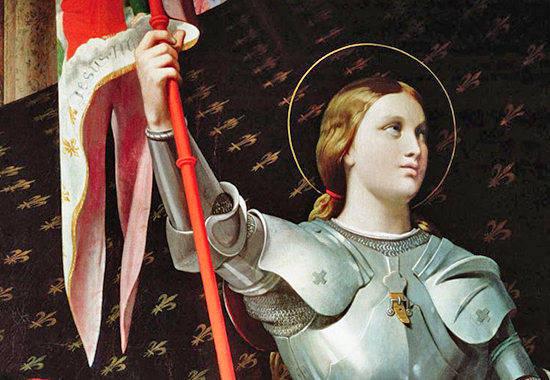
Image
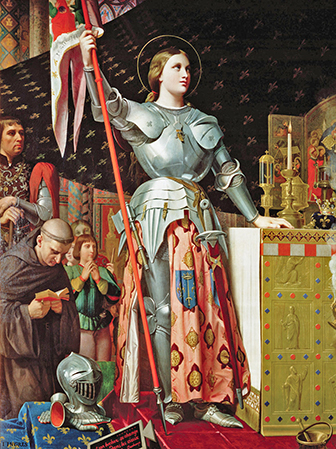
Above
St. Joan of Arc
supporting the flag at Charles VII's coronation in
Rheims Cathedral
Detail from Jean-Auguste-Dominique
Ingres' painting, oil on canvas, created in
1854. See entire painting at the end of this
page.
Louvre, Paris. |
Who Was
Joan of Arc?
Joan was also called
The Maid of Orléans, or, if you are French,
Sainte Jeanne d'Arc or
La Pucelle (pucelle =
maid).
Joan was a very courageous young woman.
She was a simple peasant girl and a strong believer. More to the
point, she claimed
that she was in tune with some of the
Saints because they spoke to her.
Joan of Arc and the
Hundred Years' War
The
 Hundred Years' War
was fought from 1337 until 1453. Hundred Years' War
was fought from 1337 until 1453.
This war had started 75 years before Joan's
birth, and it ended 22 years after Joan's death.
If you know about Joan of Arc, you
already know quite a bit about the Hundred Years' War
because Joan was soldier of the month
in this war, several months in a row, thanks to her performance at the
Siege
of Orleans, which ended in May 1429.
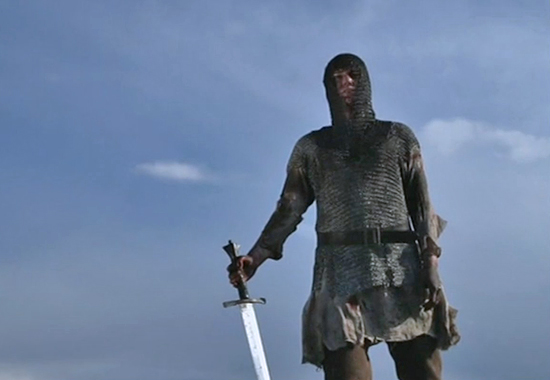
Joan of Arc in Battle
Attire
From Ken Follett's Journey
into the Dark Ages
But let's start at the beginning.
Joan's Background and
Early Life
Joan's father was the pious peasant
Jacques d'Arc who lived
in the village of Domremy, or Domrémy. Joan was born in Domremy as
well.
Here is Domremy on a map. Look for
the B/VI square:
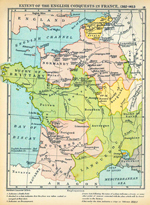
France
1382 - 1453
Click map to enlarge
Domrémy, Joan's home town, was located
in the Duchy of Bar. The Duchy of Bar became part of Lorraine in
1480. By then, of course, Joan was long gone.
You are welcome to visit Joan
of Arc's birthplace at Domremy, which is now a humble little museum.
Today, the
tiny village of Domremy is home to about 200 residents. And
here is a recent photo:
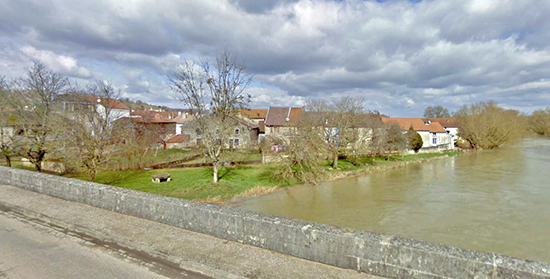
Domrémy-la-Pucelle,
Vosges département, Lorraine région, France
Google
Growing up during the Hundred Years'
War, Joan's family had to flee their home several times to escape
either Burgundian or English raiders. Thus, Joan developed a strong
patriotic sense.
Check the map above to see how France
was sandwiched by the English on the mainland and Burgundy.
And here is more on the
Burgundians.
This painting shows Joan in her early
days. We see her standing in the garden of her parents at that exact
moment when The Voices made contact.
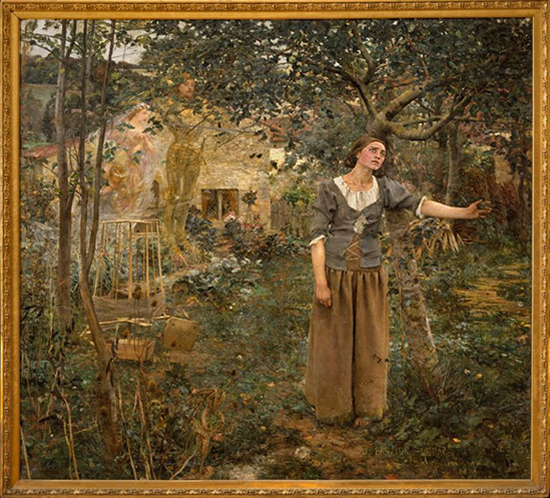
Joan of Arc
Painting by Jules
Bastien-Lepage, who created it in 1879. Oil on canvas.
Metropolitan Museum of Art
Painter Jules Bastien-Lepage, himself hailing from Damvillers, Lorraine,
received some harsh comments from the
critics, who could not appreciate his mixture of naturalism and mysticism.
Back to Joan.
Joan of Arc's Impossible Mission
According to herself, and well ahead of her age group, Joan started
hearing voices when she was only thirteen years old.
Who were these voices, and what did
they want?
The voices, who
revealed themselves as St. Michael
(main man),
St. Catherine of Alexandria (legendary
young Christian girl, later martyr, struggling against persecution
under the Roman emperor Maxentius in the 4th century), and
St. Margaret of Antioch (legendary
virgin, later martyr, whom even the
Devil himself could not digest [long story]), told Joan that she
was to save France.
So far, so good.
As Joan grew older, the voices became
more specific. They informed her that she was the instrument chosen by Heaven
itself to drive away the English. Her mission, should she choose to
accept it, was to bring the Dauphin to Rheims
(or Reims) where he would become anointed king.
Joan of Arc immediately notified her parents, packed her bundle, and was on her
way.
A dauphin, by the way, is the
title of the eldest son of the King of France. This title was in use from 1349 to 1830.
Operation Rheims
First task on Joan's list was
to make contact with the Sire de Baudricourt in Vaucouleurs.
The people of Vaucouleurs were
intrigued by young Joan, partly because of
her piety and devoutness, partly because of her spunk and
enthusiasm, but mostly because of her ability to tie all of the above
together with patriotism that, frankly, was as solid as it was
badly needed.
Joan explained to the good citizens of
Vaucouleurs that the voices had asked her to dress up as a knight. The townspeople
were delighted and fell into competition with each other to equip the girl with the
best horse, armor, and sword.
Mr. Baudricourt himself arranged for an escort and
a very sharp looking Joan was accompanied to the French town of Chinon where she was to meet the
Dauphin
Charles.
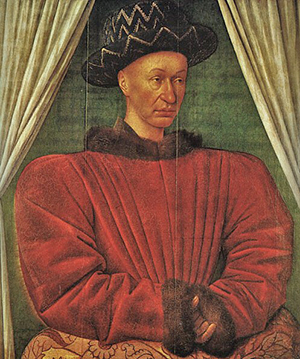
French King Charles VII, formerly the
Dauphin Charles, around 1447
Painting by Jean Fouquet,
Louvre, Paris
Photo PHGCOM, Wiki
It was February 1429. Having arrived
at Chinon, Joan was invited
into a room full of people in fancy outfits. Among these people
mingled Charles, whose attire was carefully selected to blend in perfectly.
Nothing gave away his true identity. The idea was
to see if Joan could identify the Dauphin, whom she never met before
in her life, on her own, which would confirm that
Heaven was in fact speaking French in general and through
Joan of Arc in particular.
Joan spotted and addressed
Charles right away. While the entire audience was still trying to figure out how
she done it — and briefly contemplated frisking her sleeves for
potential flower bouquets — Joan kept on track and prompted
Charles on his new agenda: He was to be crowned
king in the city of Rheims. Chop chop.
"Is it your Voices that command you to say that
to the King?"
"Yes, and urgently."
Mark Twain in
Personal Recollections of Joan of Arc, 1895
Really? Not quite.
Joan had a private meeting with
Charles before the big official first introduction and could
therefore easily recognize him. Welcome to political stunts of the
Middle Ages.
Joan of Arc —
Accomplishments
Up to this point in the Hundred Years'
War, the French did not perform very well. Their lands were
destroyed and their morale was shattered. But now that Providence
had seemingly taken a
breath mint, an invigorating wind of change blew across the land.
A Holy Maid led the way, and France felt perky again.
And then events happened with the
quickness:
Joan visited the French camp at Blois,
and on April 25, 1429, she left for Orleans, where she arrived on
April 28. By May 8 the English raised the
Siege
of Orleans.
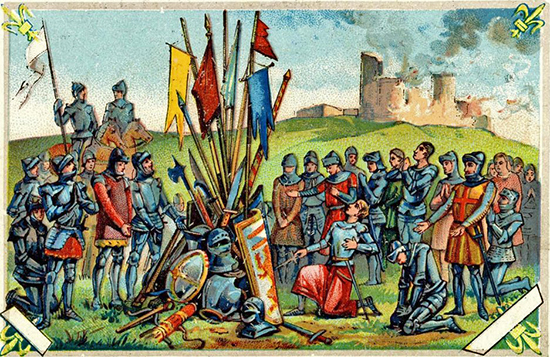
Joan of Arc Thanking
God After the Battle of Patay,
Decisive French Victory — June 18, 1429
Unknown artist, Musée des
Civilisations de l'Europe et de la Méditerranée, Paris
On July 17, 1429, Charles VII was crowned at Rheims.
So, in a Nutshell, What
Was Joan of Arc's Greatest Accomplishment?
Her courage and her loyalty to Charles
VII.
It was thanks to her that the Siege of
Orleans became the turning point in the Hundred Years' War and
France eventually managed to win this war.
"Then what did the Voice say?"
"It told me to answer boldly, and God would help
me."
Mark Twain in
Personal Recollections of Joan of Arc, 1895
Joan's Life After Rheims
Joan went on to fight as a soldier in
Charles' army and saw battle at Laon, Soissons, and Beauvais.
In September 1429, Joan was severely
wounded while trying to take Paris in the name of her king.
Joan of Arc in Action
Gutenberg Project
Click image to
enlarge
The Death of Joan of Arc
It was 1430 and spring when a strong Burgundian force besieged the fortress of
Compiegne. On May 24, 1430, the
besieged tried to make a break for it, but weren't successful. Joan was taken
prisoner by the Burgundians.
Being basically the enemy's mascot, Joan was somewhat of a catch for the Burgundians,
who brought her to Arras
and later to Crotoy on the Flemish coast. In November 1430, the Burgundians sold her to the English
for a good buck.
The English, too, believed that Joan
had connections to other dimensions, but were convinced that these
associations were clearly of the evil kind. Hence, they brought her
to Rouen, an English stronghold in France at the time (Henry V of
England had taken Rouen in 1419), put her on trial, and burned Joan at the stake on
the Place du Vieux-Marché.
When did Joan of Arc die?
It was on May 30, 1431. Joan was
19 years old.
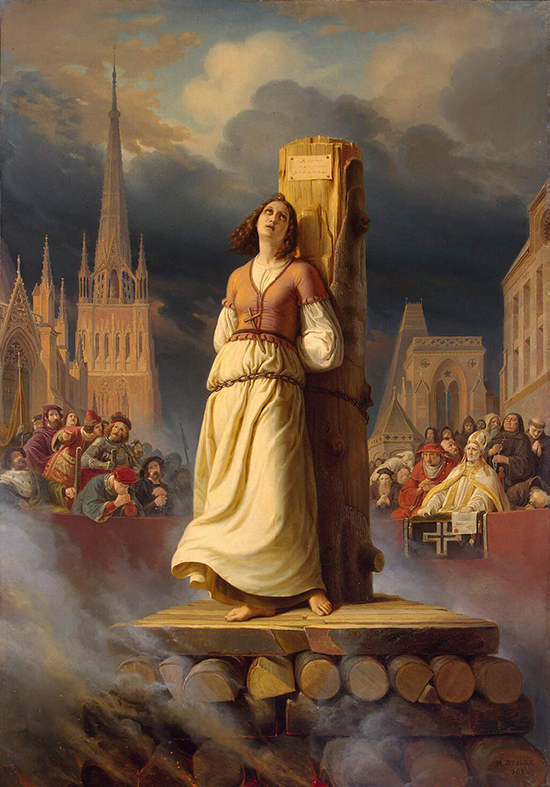
Joan of Arc's Death at
the Stake
Oil on canvas by Hermann Anton
Stilke, 1843
State Hermitage Museum
How Joan of Arc Became
Saint Joan of Arc
Joan of Arc became the official patron
saint of France, soldiers, and all girls who like to tomboy, when she was canonized by
Benedict XV on May 16, 1920.
That's right, after nearly 500 years
of holy forgetfulness
World War I hit, and the demand
for a morale booster was of such magnitude that church historians
boldly looked everywhere, even in the carefully hidden file cabinet
labeled "Middle Ages". Which couldn't have been for the faint of
heart, let's face it.
And it was very much a case of
selective recollection. The memory of
Pierre Cauchon, who was the Bishop of Beauvais and the judge chiefly
responsible for Joan's death sentence in the first place, is rarely
evoked.
Cauchon, a bishop of the Catholic
Church, was pro-English (as was the University of Paris, by the
way), hence the verdict.
It therefore took a pope to revise
Cauchon's judgment. This took place in 1456, when
Pope Calixtus III declared it
null and void and Joan posthumously innocent.
Joan of Arc and
National Holidays
Joan is still a national hero in
France.
Annually on the second Sunday in May, the French (ironically
including the Burgundians) enjoy a national holiday
in honor of the incredible amount of guts the Maid Joan of Arc had shown.
Sick, tired, and depressed because of people who achieved
amazing things before their twentieth birthday?
Attention suicidal late bloomers:
-
And finally, it took Harriette
Thompson 92 years to become the oldest woman to complete a marathon
when, in 2015, she finished the San Diego Rock 'n' Roll Marathon in
7:24:36. But now you start feeling bad again ...
Joan of Arc — Residue
Trivia
Although they burned her
at the stake, we got some smart dudes
here discussing whether or not they found
some bones that once were
on good ol' Joan.
April 4, 2007 - Update...
National Geographic reports that the relics are not Joan's but
rather that of an Egyptian mummy. Close call.
Joan of Arc Movies
Ingrid Bergman was Joan of Arc twice.
First at age 33 in 1948 with Gone With the Wind director Victor Fleming, and
then in 1954 with husband Roberto Rossellini directing. At this
point the lady was 39 years old. Takes a Bergman to pull that off.
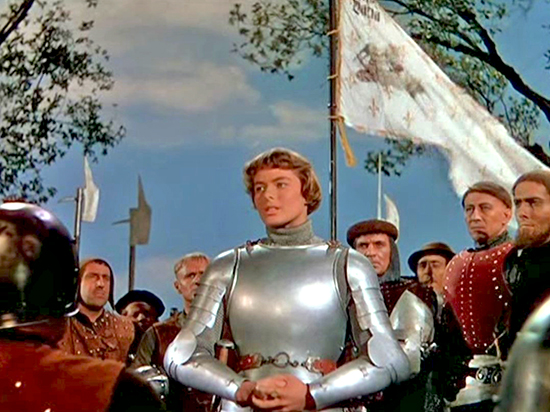
Ingrid Bergman is Joan
of Arc, 1948
Sierra Pictures
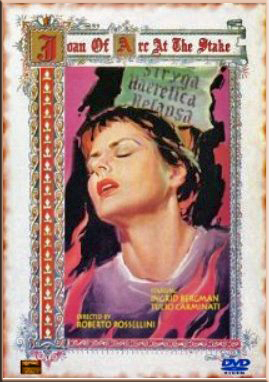
Ingrid Bergman is Joan
of Arc, 1954
Produzioni Cinematografiche
Associate
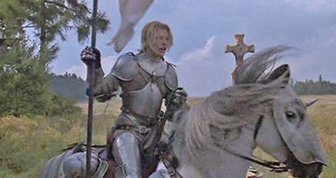
The other way around is equally
impressive. In 1999, Leelee Sobieski was 16 years old when Canada's
Christian Duguay directed her as, and in, Joan of Arc.
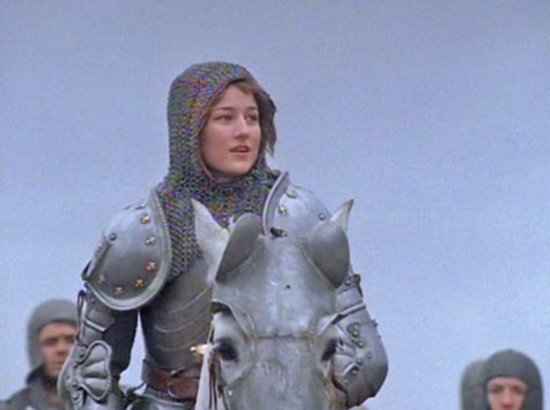
Leelee Sobieski is
Joan of Arc, 1999
Alliance Atlantis
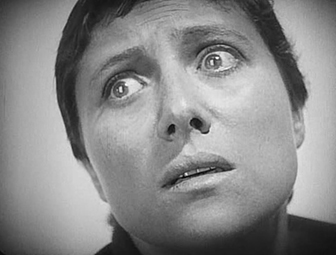
A real gem is Robert Bresson's 1962
French movie The Trial of Joan of Arc (Procès de Jeanne
d'Arc) starring Florence Delay as Jeanne d'Arc, based on the
transcripts of Joan's real-life trial.
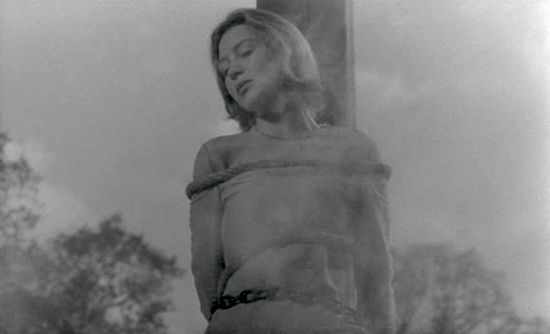
Florence Delay is Joan
of Arc, 1962
Agnes Delahaie
More Joan
of Arc movies in the right column.
Best Joan of Arc Quote
Mit der Dummheit kämpfen
Götter selbst vergebens.
With stupidity the gods
themselves struggle in vain.
Friedrich von Schiller in Die Jungfrau von
Orleans, 1801
More History
|